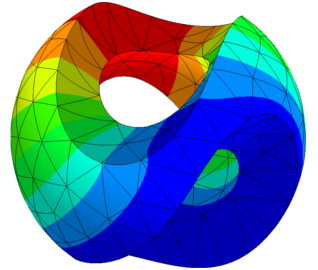
2.4.1 Maxwell eigenvalue problem#
We solve the Maxwell eigenvalue problem
\[\int \operatorname{curl} u \, \operatorname{curl} v
= \lambda \int u v\]
for \(u, v \; \bot \; \nabla H^1\) using a PINVIT solver from the ngsolve solvers module.
The orthogonality to gradient fields is important to eliminate the huge number of zero eigenvalues. The orthogonal sub-space is implemented using a Poisson projection:
\[P u = u - \nabla \Delta^{-1} \operatorname{div} u\]
The algorithm and example is take form the Phd thesis of Sabine Zaglmayr, p 145-150.
[ ]:
from ngsolve import *
from ngsolve.webgui import Draw
from netgen.occ import *
[ ]:
from netgen.occ import *

cube1 = Box( (-1,-1,-1), (1,1,1) )

cube2 = Box( (0,0,0), (2,2,2) )
cube2.edges.hpref=1    # mark edges for geometric refinement

fichera = cube1-cube2

Draw (fichera);
[ ]:
mesh = Mesh(OCCGeometry(fichera).GenerateMesh(maxh=0.4))
mesh.RefineHP(levels=2, factor=0.2)
Draw (mesh);
[ ]:
# SetHeapSize(100*1000*1000)

fes = HCurl(mesh, order=3)
print ("ndof =", fes.ndof)
u,v = fes.TnT()

a = BilinearForm(curl(u)*curl(v)*dx)
m = BilinearForm(u*v*dx)

apre = BilinearForm(curl(u)*curl(v)*dx + u*v*dx)
pre = Preconditioner(apre, "direct", inverse="sparsecholesky")
[ ]:
with TaskManager():
    a.Assemble()
    m.Assemble()
    apre.Assemble()

    # build gradient matrix as sparse matrix (and corresponding scalar FESpace)
    gradmat, fesh1 = fes.CreateGradient()


    gradmattrans = gradmat.CreateTranspose() # transpose sparse matrix
    math1 = gradmattrans @ m.mat @ gradmat   # multiply matrices
    math1[0,0] += 1     # fix the 1-dim kernel
    invh1 = math1.Inverse(inverse="sparsecholesky")

    # build the Poisson projector with operator Algebra:
    proj = IdentityMatrix() - gradmat @ invh1 @ gradmattrans @ m.mat

    projpre = proj @ pre.mat

    evals, evecs = solvers.PINVIT(a.mat, m.mat, pre=projpre, num=12, maxit=20)
[ ]:
print ("Eigenvalues")
for lam in evals:
    print (lam)
[ ]:
gfu = GridFunction(fes, multidim=len(evecs))
for i in range(len(evecs)):
    gfu.vecs[i].data = evecs[i]
Draw (Norm(gfu), mesh, order=4, min=0, max=2);
[ ]:
[ ]: